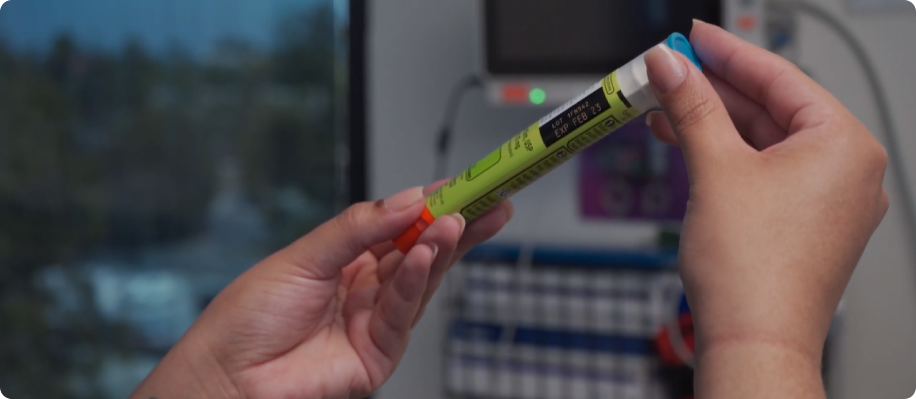
Join families, schools, and communities learning how to respond confidently in a food allergy emergency. Backed by proven guidelines and practical instruction, our Epinephrine Auto-Injector Training empowers people of all ages to act quickly and safely when it matters most.
The Urgent Need for Anaphylaxis Awareness and Preparedness
Approximately 33 million Americans, including 5.6 million children under 18, suffer from food allergies. This amounts to about one in 13 children or two per children classroom*.
The prevalence of food allergies has risen over the last 20 years, making food anaphylaxis a global health crisis.
Anaphylaxis is a rapid and life-threatening allergic reaction that requires immediate medical intervention and can be fatal within 15 minutes without proper treatment. Epinephrine is the first-line treatment for anaphylaxis and is the most effective way to quickly reverse symptoms.
At Food Allergy Institute, we believe that recognizing anaphylaxis and knowing how to use an epinephrine auto-injector should be as common as knowing how to perform CPR (cardiopulmonary resuscitation).
*Source: FARE
Epinephrine Auto-Injector Courses
Course are available virtually using the options below, making it easy for anyone to learn at their own pace. To schedule an in-person training for your school, community organization, or business, contact us.
This virtual training course is great for any individual who would like to learn about anaphylaxis and how to use an epinephrine auto-injector, or for anyone who needs a refresher course.
Our Basic EAI Training Course is available to individuals located anywhere across the world.
For laypersons and businesses, we provide virtual EMSA-Approved training programs. These programs are designed to equip those in California with the necessary knowledge and skills to identify anaphylaxis symptoms and administer EAIs effectively.
As an EMSA-Approved course, California residents can also apply for an EMSA Epinephrine Certificate. This certificate enables individuals and businesses to obtain a prescription from a physician to carry stock epinephrine for use in emergency situations.
*** Please Note: For proper completion of this training course, you will need to have TWO Epinephrine Auto-Injector Trainers to show proficiency in deploying an EAI.
All Things Allergy Educational Session for Staff (In-Person/Virtual)
Training on "All Things Food Allergies"covers a comprehensive range of topics.This informative session is tailored for teachers and administrators seeking to understand food allergies, anaphylaxis, their impact on children and those around them, and the proper use of various epinephrine auto-injectors.
Our in-person training is available to both private and public schools in LA, OC, and San Diego. For those outside of Southern California, we are more than happy to offer a virtual session!
If you suffer from life-threatening food allergies or have someone in your care who does, print the Food Allergy and Anaphylaxis Emergency Care Plan. Once it is printed, have it completed by their physician and then keep it with the epinephrine auto-injector for the child's safety. Each child’s safety is our priority!
Our in-house food laboratory produces allergen gummies, en
Anaphylaxis is a potentially life-threatening allergic reaction that can quickly worsen following the initial appearance of symptoms. Download our “Signs and Symptoms of Anaphylaxis Posters” to familiarize yourself with the various indicators linked to anaphylactic reactions across different age groups, including infants, school-age children, and individuals leading various lifestyles.
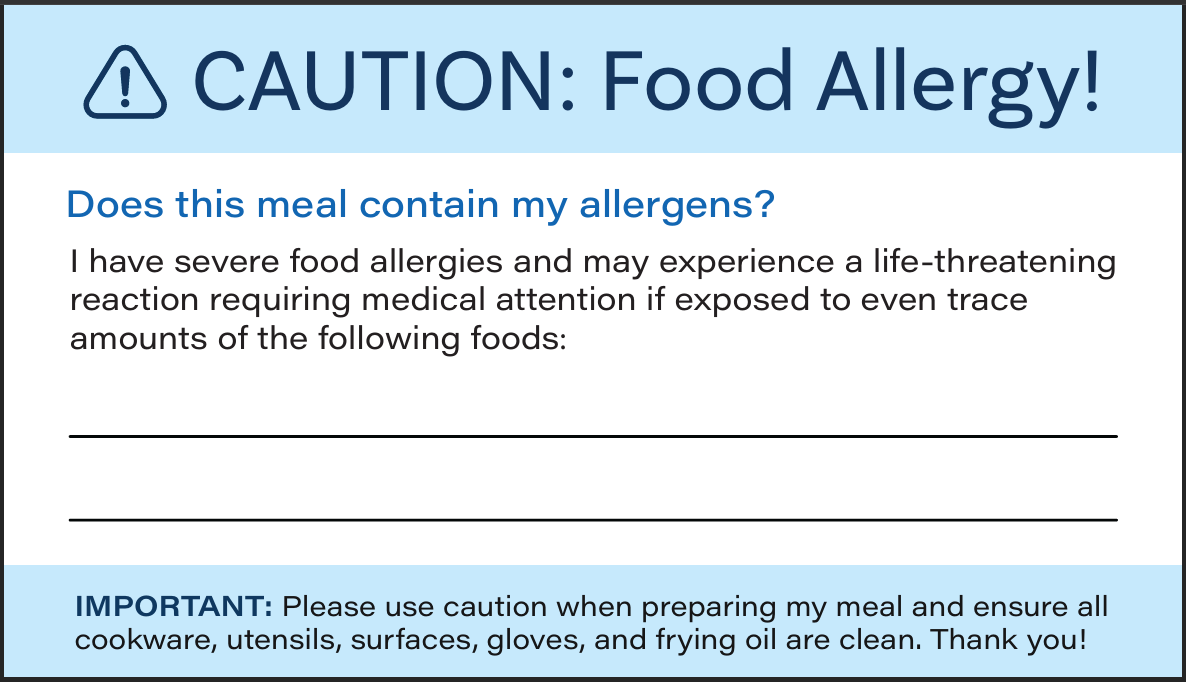
Whether you are traveling, at school, or dining out, our Food Allergy Card can help inform others of your allergies and keep you safe as you visit new places.
1. Remove the EpiPen® or EpiPen Jr® Auto-Injector from the clear carrier tube. 2. Grasp the auto-injector in your fist with the orange tip (needle end) pointing downward. 3. With your other hand, remove the blue safety release by pulling straight up. 4. Swing and push the auto-injector firmly into the middle of the outer thigh until it ‘clicks’. 5. Hold firmly in place for 3 seconds (count slowly 1, 2, 3). 6. Remove and massage the injection area for 10 seconds. 7. Call 911 and get emergency medical help right away.
1. Remove Auvi-Q from the outer case. 2. Pull off the red safety guard. 3. Place the black end of Auvi-Q against the middle of the outer thigh. 4. Press firmly until you hear a click and hiss sound, and hold in place for 2 seconds. 5. Call 911 and get emergency medical help right away.
If you suffer from life-threatening food allergies or have someone in your care who does, print the Food Allergy and Anaphylaxis Emergency Care Plan. Once it is printed, have it completed by their physician and then keep it with the epinephrine auto-injector for the child's safety. Each child’s safety is our priority!
Our in-house food laboratory produces allergen gummies, en
Anaphylaxis is a potentially life-threatening allergic reaction that can quickly worsen following the initial appearance of symptoms. Download our “Signs and Symptoms of Anaphylaxis Posters” to familiarize yourself with the various indicators linked to anaphylactic reactions across different age groups, including infants, school-age children, and individuals leading various lifestyles.
Whether you are traveling, at school, or dining out, our Food Allergy Card can help inform others of your allergies and keep you safe as you visit new places.
1. Remove the EpiPen® or EpiPen Jr® Auto-Injector from the clear carrier tube. 2. Grasp the auto-injector in your fist with the orange tip (needle end) pointing downward. 3. With your other hand, remove the blue safety release by pulling straight up. 4. Swing and push the auto-injector firmly into the middle of the outer thigh until it ‘clicks’. 5. Hold firmly in place for 3 seconds (count slowly 1, 2, 3). 6. Remove and massage the injection area for 10 seconds. 7. Call 911 and get emergency medical help right away.
1. Remove Auvi-Q from the outer case. 2. Pull off the red safety guard. 3. Place the black end of Auvi-Q against the middle of the outer thigh. 4. Press firmly until you hear a click and hiss sound, and hold in place for 2 seconds. 5. Call 911 and get emergency medical help right away.



.png)


.png)